


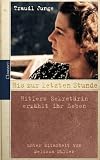
Traudl Junge. Bis zur letzten Stunde: Hitlers SekretÖ¤rin erzÖ¤hlt ihr Leben. Munich: Claassen Verlag, 2002. 272 pp. EUR 19.00 (paper), ISBN 978-3-546-00311-7.
Reviewed by Gerald Weinberg (Department of History (Emeritus), University of North Carolina at Chapel Hill)
Published on H-German (March, 2004)
The main portion of this book is the author's memoir of her years as one of Adolf Hitler's secretaries from the beginning of 1943 until his suicide in 1945, as written in 1947-1948. This text is preceded by a brief description of Junge's family and youth before she went to work in the Reich Chancellery. It was written by the journalist Melissa Mueller, who also provides the account of Junge's life after the war that follows the memoir. The notes are primarily very useful identifications of the many individuals mentioned in the memoir.
Traudl Humps was one of two daughters of a broken Munich family. Raised by her mother, she decided early that she wanted to become a dancer as her younger sister appeared likely to become. When a position she held in Munich would neither allow her enough time to practice dancing nor, under the circumstances of the German wartime labor laws, allow her to quit, the young woman (born in 1920) used a family connection to have herself transferred to the Reich Chancellery in Berlin, where she expected to be able to pursue her interest in dance. It worked out very differently. She was sent with a group of other secretaries to Hitler's East Prussian headquarters in late 1942 for Hitler to select a replacement for a secretary who had left when she married. She found herself picked right away. Since Hitler did not really test the others as he did her, it is reasonable to deduce that her Munich background influenced his choice.
From that point in time until the day of Hitler's suicide, Traudl Humps, who became Mrs. Junge when she married one of Hitler's adjutants, remained with Hitler. Her account of the daily routine at headquarters, the train and airplane travels, the periodic stays at the Berghof in Bavaria, and the circumstances in Berlin during the last months of the war are entirely credible in this reviewer's opinion. Despite occasional confusions in the chronology, the details have the ring of authenticity. The memoir includes descriptions of people at headquarters and a clearer picture of Eva Braun's position and role than can be found elsewhere. The recollections of the assassination attempt on July 20, 1944, which Junge experienced at headquarters (pp. 143-152), is dramatic even if it adds little to our knowledge. Hitler's close personal relationship with Albert Speer, his admiration for Benito Mussolini, and his loyalty to comrades from the 1920s were commented on by Junge at a time when these were not generally so pictured in the literature. She included summaries of these impressions and of her memories of Hitler's enthusiasm when the V-1 and V-2 weapons hit England in a shorter account that she gave to David Irving. He deposited it at the Institute for Contemporary History in Munich, where she allowed this reviewer to read it in 1978.
What is the point of it all? Beyond the extensive detail of the routines in headquarters and of the ghastly final days in Berlin, the book illuminates something the author did not realize until far too late. She notes repeatedly that Hitler was careful not to look at German cities damaged by bombing and had no sense for the sufferings of his people. At the same time, she is really describing herself and many others in Germany before and even during the war. She drew no lessons from the forced sterilization of her uncle or the emigration of the Jewish family that had enabled her to have dancing lessons--to say nothing of other countries' suffering from bombing. Even the death, at the front, of the husband she had just married appears to have produced a most minimal impact. She lived blindly in the comforts of headquarters through the discomforts and horrors of the final days of the Third Reich. It was only years after she typed Hitler's last testaments that she noticed the Munich memorial to Sophie Scholl, a student younger than Junge who had seen what Junge had not noticed and had tried to rouse her fellow Germans against it. Perhaps the daughter of the Jewish family who had helped her, emigrated, and then returned briefly to Germany and visited her after the war had it right when she commented that "the time with Hitler had ruined her [Traudl Junge's] life" (p. 258).
Copyright (c) 2004 by H-Net, all rights reserved. H-Net permits the redistribution and reprinting of this work for nonprofit, educational purposes, with full and accurate attribution to the author, web location, date of publication, originating list, and H-Net: Humanities & Social Sciences Online. For other uses contact the Reviews editorial staff: hbooks@mail.h-net.msu.edu.
If there is additional discussion of this review, you may access it through the network, at: https://networks.h-net.org/h-german.
Citation:
Gerald Weinberg. Review of Junge, Traudl, Bis zur letzten Stunde: Hitlers SekretÖ¤rin erzÖ¤hlt ihr Leben.
H-German, H-Net Reviews.
March, 2004.
URL: http://www.h-net.org/reviews/showrev.php?id=8985
Copyright © 2004 by H-Net, all rights reserved. H-Net permits the redistribution and reprinting of this work for nonprofit, educational purposes, with full and accurate attribution to the author, web location, date of publication, originating list, and H-Net: Humanities & Social Sciences Online. For any other proposed use, contact the Reviews editorial staff at hbooks@mail.h-net.org.

