


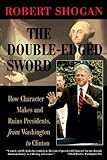
Robert Shogan. The Double-Edged Sword: How Character Makes and Ruins Presidents, from Washington to Clinton. Boulder: Westview Press, 1999. xii + 284 pp. $25.00 (cloth), ISBN 978-0-8133-6777-4.
Reviewed by Richard Shenkman (Editor, HistoryNewsNetwork.org)
Published on H-Pol (April, 2001)
Character Counts?
Character Counts?
In polite circles long ago you didn't bring up the subjects of either religion or politics. Now, unless you want to start a row, a third is off-limits: presidential character, which concerns both. Judging by the television talk shows, this word brings out the worst in people.
It was therefore with pleasure that I agreed to review Robert Shogan's book, The Double-Edged Sword: How Character Makes and Ruins Presidents, from Washington to Clinton. I figured we could use a dispassionate analysis which puts the topic in perspective. Unfortunately, Mr. Shogan's book only makes matters worse. Now the disputants will have more facts to fire in all directions thanks to his chronicle of presidential imperfections, without being any the wiser.
Shogan's thesis, as stated in the first chapter, is that American politics is shaped by both character and values. The good news, he says, is that "their responsible use can help politicians forge coalitions to break the gridlock that at times seems to paralyze the political process -- and can also help the media to enlighten readers and viewers. The bad news is that the misuse of character and values drowns out substantive arguments, distorts reality, and undermines the public confidence in politics and the press" (p. 7).
To bolster his case, Shogan takes the reader on a rollicking romp through American history. Most of the book concerns recent presidents, and includes two chapters on Clinton. But Shogan states at the outset that his book was not written in response to the scandal involving Monica Lewinsky. (The book was published in hardcover before the outcome of the impeachment trial in the Senate was known.) And indeed at least half the book covers pre-modern presidents, namely, Washington, Jefferson, Jackson, Lincoln, Theodore Roosevelt, and Wilson.
Shogan is on the side of those who believe that character counts and that it always has. As proof, he notes that Washington's character was a critical factor in the Founding Father's decision to establish the presidency as a powerful institution. But the level of analysis is thin. For instance: Because Jefferson has an affair with Sally Hemings he is a man of weak character. Because he is a man of weak character he is willing time and again to break his principles and brazenly lie. Because he breaks his principles and lies he establishes "a paradigm for deviousness and dissembling that most of his successors have been only too glad to follow" (p. 41).
We have been down this road before. A generation ago James David Barber, far more brilliantly than Shogan, revealed how the make-up of the individual affects presidential performance, sometimes for good, sometimes for bad (the double-edged sword). Most historians and political scientists would agree that character plays a decisive role in the course different presidencies take. As the saying goes, the presidency is what the man who happens to hold the office at a particular time makes of it. Teddy Roosevelt was one kind of president, Jimmy Carter another.
Given the scandals of the last forty years involving Vietnam, Watergate, Iran-contra, and Monica, it may seem reasonable to focus on character as a driving force in American politics. But surely there is far more to the presidency than character. The system, too, presumably shapes the way the individual gains power and wields it. I would guess that most historians would agree that the democratic system of mass politics ultimately is a more decisive force in the way the game of politics is played than is character.
Politicians often lie, deceive and compromise not because they are necessarily men of weak character after all but because the only way to succeed in politics under our system is often to lie, deceive and compromise. Even the men known for their good character succumb to the pressures from time to time. They reinvent themselves, exploit their families, compromise their principles, manipulate emotions, and commit all sorts of other offenses that the pure of heart find nauseating -- but that is the price they felt had to be paid for success. That some are purer than others is true. But none ever escape entirely the pressure to bend and weave.
It was not always this way. In the early years of the Republic presidents needed to make far fewer compromises than later. The chief change in American politics occurred in the 1830s when the masses became eligible to vote. Before this period presidents were selected mainly on the basis of their resumes, judgment and character. Afterward, they gained election only by making an emotional connection with voters, often through the manipulation of potent symbols. This change in politics is often identified with the election of 1840, which featured the packaging of William Henry Harrison, a child of privilege, as the log cabin hero of the people. Shogan strangely ignores this election.
Shogan is not unaware of the role the system plays in shaping American politics. A journalist by training, he skillfully chronicles the changing behavior of the American media in the twentieth century, showing that the very same offenses committed by John Kennedy and Bill Clinton received far different coverage, leading to far different consequences for their presidencies. But Shogan fails to carry his analysis to its logical conclusion: That it is not necessarily the character of the president that drives American politics.
A secondary misunderstanding is his implicit faith in an unchanging definition of character. His own evidence adduces the fact that this is not so. Standards of character change. Thus, it is too easy to suggest that a man who is unfaithful to his wife cannot be trusted with the public's business. The American public at different times has reached different conclusions about this question, which no doubt accounts in part for Bill Clinton's political survival.
Besides what counts is not so much the character of a president as the public's perception of his character. Perceptions, too, are shaped by the system. Once radio and television became dominant forces, for instance, voters began to confuse personality with character. A person with the talent for coming across as a straight shooter was believed to be one. Image was everything, as John H. Summers recently has pointed out in a path-breaking article in the Journal of American History (December 2000). Given the recent success presidents have had inventing images the public likes, character would seem to be ever decreasingly important. Would it have made a difference if Ronald Reagan, for instance, was in reality the family man he claimed to be? Much as some of us might not like to admit it, the answer is that it probably wouldn't have made the least bit of difference (except, of course, to his children, fewer of whom would possibly have felt the necessity of turning to therapy for help in dealing with a distant father).
Shogan, committing early on to a broad definition of character -- he writes in the first chapter that it is the "sum of a politician's psyche and personality" -- overlooks the change Summers identifies, a serious defect. And by defining character the way Shogan does, he robs the term of the moral meaning he otherwise seeks to explore. Hence the ungrammatical subtitle of the book: How Character Makes and Ruins Presidents. How in fact has character ever ruined a president? Personality flaws might, but not character, at least not character as the word is commonly understood.
Shogan, who covered seven presidents for Newsweek, knows how to tell a story and tells particularly compelling stories about the leaders he had the opportunity to interview. Thus, the book gets better as it goes along. His account of the Clinton scandals is especially interesting despite the familiarity of most of the material. He answers one question many people have had about Bob Dole's odd decision in 1996 not to go after Clinton's philandering. Shogan reveals that Dole apparently worried that the media would find out that he had had an affair twenty-eight years earlier. (This will be news to readers like myself who mainly relied on the New York Times for information about the campaign. But the affair was reported in other less circumspect papers.)
The delightful anecdotes and tidbits of knowledge, however diverting, are not sufficiently worthwhile to lead me to recommend this book. What readers deserve is a history that helps them understand the question Shogan sets out to answer: What the connection is between presidential character and performance.
I admit to having strong reservations, too, about his conclusion. Shogan is of the opinion that the media should be encouraged to dwell on politicians' character. "There is no better way," he argues, "of choosing a candidate for president than by evaluating what kind of human being he -- or she -- really is." This is a seemingly uncontroversial recommendation, one with which the Founding Fathers undoubtedly would have agreed. Given the choice who wouldn't want to know more rather than less about a candidate's character? But the ease with which candidates today can manipulate their image, confusing both the public and the media, makes me for one doubtful of the wisdom of this approach. After all, how did Al Gore, the man of character in 1992 become Al Gore, the man who couldn't be trusted in 2000? Had he changed? Either the media was manipulated in 1992 or in 2000, thereby misleading the voters.
A kind of Gresham's law is at work in modern campaigns that bodes ill for the conduct of politics. The more the media focus on character studies, the less they focus on issues. Stories about character, particularly lurid ones, almost always drive out substantive stories about dreary subjects like tax policy.
Americans are obviously confused about the role character should play in our selection of presidents. While we welcome the quadrennial media analyses of character, we recoil when the candidates themselves bring up the subject. We don't want them bragging about their own character or deriding the character of their opponents. A candidate who talks about character often seems to lack character. Thus, the consensus: Candidates can safely talk only about issues. The media alone can be trusted to decide questions of character.
The Founding Fathers would be confounded by the consensus Americans have reached, as John Summers has observed. They held that candidates should never talk about the issues. The Founders feared that if elections turned on issues, candidates would be encouraged to attract mass support by promising to take from the rich and give to the poor.
The reality of modern politics is that we have the worst of both worlds. Democrats talk about the issues to attract the support of the masses, to whom Democrats promise middle class benefits paid for by taxes on the rich. Republicans talk about character as a ruse to avoid disclosure of their real (and unpopular?) positions on issues like the environment and abortion.
So just focus on character? That approach alone doesn't begin to address the complexity of the challenge.
Copyright (c) 2001 by H-Net, all rights reserved. This work may be copied for non-profit educational use if proper credit is given to the author and the list. For other permission, please contact H-Net@h-net.msu.edu.
If there is additional discussion of this review, you may access it through the network, at: https://networks.h-net.org/h-pol.
Citation:
Richard Shenkman. Review of Shogan, Robert, The Double-Edged Sword: How Character Makes and Ruins Presidents, from Washington to Clinton.
H-Pol, H-Net Reviews.
April, 2001.
URL: http://www.h-net.org/reviews/showrev.php?id=5067
Copyright © 2001 by H-Net, all rights reserved. H-Net permits the redistribution and reprinting of this work for nonprofit, educational purposes, with full and accurate attribution to the author, web location, date of publication, originating list, and H-Net: Humanities & Social Sciences Online. For any other proposed use, contact the Reviews editorial staff at hbooks@mail.h-net.org.

