


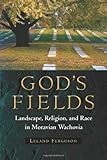
Leland Ferguson. God's Fields: Landscape, Religion, and Race in Moravian Wachovia. Gainesville: University Press of Florida, 2011. xx + 276 pp. $74.95 (cloth), ISBN 978-0-8130-3748-6.
Reviewed by Scott Rohrer
Published on H-Pietism (January, 2013)
Commissioned by Jared S. Burkholder (Grace College)
Unearthing Evidence about Moravians and Race
Leland Ferguson, an archaeologist from the University of South Carolina, spent more than twenty years digging in a patch of ground near downtown Winston-Salem, North Carolina. It was a labor of love and an apt testimonial to a book that, quite literally, uncovers a riveting story about race and religion in the American South. The focus of Ferguson’s intensive efforts was a former graveyard on the front lawn of a decrepit former brick church known as St. Philips, the resting place of “strangers” and African Americans from the eighteenth and nineteenth centuries. The gravestones and fencing were long gone by the time Ferguson’s team arrived on the scene, and what remained on the landscape and in the archives was something of a mystery. Who was buried there, and what were their stories?
A typical setting, this book is not. Nor is God’s Fields a standard tome on the Moravian settlement known as Wachovia that was founded in 1753. Instead, God’s Fields offers something different, and valuable, to historians of religion as it weaves back and forth between the present and the past, mixing first-person recollections with explorations into Moravian slavery and religious practices. The forays into current events--the author discusses everything from his growing up near Wachovia, to the preservation philosophy of Old Salem Inc., to the Moravian Church’s decision to apologize for slaveholding--are unusual and effective, and they build tension into one of the author’s central stories--how the Moravians, a devout, almost utopian, pietist group, became slaveholding segregationists. Jon F. Sensbach’s A Separate Canaan: The Making of an Afro-Moravian World in North Carolina, 1763-1840 (1998) probed this question eloquently more than a decade ago, and Ferguson builds on Sensbach’s findings by studying the landscape and the ways that the Moravians’ pietist values worked in practice.
As Ferguson reminds the reader, landscape is an important marker of religious beliefs, and the Moravians’ burial grounds were especially revealing about their attitudes on theology and community. “Moravian graveyards are often associated with hills,” Ferguson observes. “Such placement fits New Testament symbolism, especially Jesus’ crucifixion on Calvary, and it also honors the God’s Acre in Herrnhut, the Unity mother settlement in Germany” (p. 124). Thus in Wachovia’s three congregation towns--Bethabara, Bethania, and Salem (the capital)--the brethren placed their burial sites on high ground. Church members were buried not by family but also by choir--the division of the church into groupings by age, sex, and gender. And, as befitting a pietist group defined by its devotion to Jesus, graves were marked by simple, flat markers, not elaborate upright stones or crypts that attested to a person’s worldly station on earth.
The treatment of African American Moravians and non-Moravians was different, however. The church placed the graveyard for these two groups at the bottom of a hill in Salem near a creek, at the opposite end from the main God’s Acre where members of the Salem congregation were buried. Ferguson’s God’s Fields explains in intriguing detail how this came to be, how the graveyard at St. Philips was used in practice, and what this evolution of burial practices reveals about the Moravian movement. The graveyard was surveyed in 1773 or 1774 by Christian Reuter on a then-empty plot on Church Street (the brick church was built in 1861 to replace a log edifice constructed in 1823), and the first “stranger”--non-Moravian--was buried there in March 1775 when Michael Jourdan, a neighbor from Guilford County, died. In these early years, white Moravians viewed their black Moravian brethren as something of Christian equals, and these blacks were often buried alongside their white brothers and sisters. Such Christian equality came to an abrupt end in 1816, when the church decreed that blacks--Moravian and non-Moravian alike--were to be buried in the strangers’ graveyard in south Salem.
Through painstaking field and archival work, Ferguson’s team carefully documents this change and shows how, in death, blacks came to be treated differently from whites. In Salem’s God’s Acre, female members were buried in the north end and males in the south. “Moravians imbued the cardinal directions and elevation with religious symbolism: east, north, and higher elevations were associated with innocence and piety, while south, west, and lower elevations were associated with experience and worldliness,” Ferguson explains (p. 152). But the graveyard at St. Philips was far more complicated. “Black Moravians, regardless of their relationship to Christ, were buried at the lowest end of Church Street in a place traditionally set aside for outsiders. The racial segregation that local Moravians had found a way to excuse was explicitly exhibited on the landscape” (p. 161). The differences in treatment extended to the types of stones that whites bought to honor the African American dead. The church, to its credit, “consistently” bought gravestones for those blacks it had enslaved, but white owners did not: according to Ferguson’s research, only fourteen out of forty-five slave owners who had slaves buried at the St. Philips graveyard bought stones.
The author’s reconstruction of the graveyard is superb and thorough, but his accounting for these changes is more problematic. Ferguson sees a declension at work in Wachovia. The original settlers at Wachovia, in the author’s view, were devout, principled, even utopian, who largely accepted black Moravians as spiritual equals. But after the American Revolution, “Salem culture changed from a congregational community completely controlled by the church to a town transformed by a swelling tide of individualism, private enterprise, and chattel slavery that overwhelmed the communalism and material simplicity of the religious community” (p. 169). Ferguson’s declension theory apparently rests on two foundations. One is the work of Perry Miller, who described the evolution of the Puritan communities in New England as a declension: the zeal of the founding era gave way to materialism and individualism as the piety of later generations waned. The second is the work of Moravian historian Jerry Surratt, whose research tells the story of a nineteenth-century Salem being swamped, and undermined, by outside forces.
Ferguson, as a result, portrays Wachovia as a place founded by pious settlers with high ideals in all things, including race relations. “In the beginning, pioneering Moravians largely overlooked race as they imagined themselves building harmonious communities of pious Christians who lived together, worshipped together, and worked for the glory of God and the salvation of souls.” These saintly Moravians were seeking a higher goal: “eternal bliss in the arms of the Savior” (p. 195). Then the idealism of the founding generation gave way to profit-seeking brethren who placed the good of the individual ahead of the needs of the church and its Savior. Such a declension is visible in the landscape, according to Ferguson, especially in the Moravians’ burial grounds. “In light of this utopian vision, the God’s Acres in Salem [and elsewhere] ... illustrate a story of dramatic change--from Christians so drenched with the Holy Spirit they barely noticed racial differences to men and women in the Salem community who embraced racially justified slavery and segregation” (p. 199).
The story of a declension is moving and seemingly plausible--after all, Moravians’ piety did change, even falter, in the nineteenth century, and capitalism and individualism did become growing forces in this religious community. But declension is simplistic and misleading for both the Puritans and the Moravians. Since the 1970s, numerous community studies have debunked Miller’s declension theory in New England, and few religious historians ascribe to it as a paradigm for other groups. In Wachovia, recent historians have debunked it as well. For starters, in his work on the Moravian colony’s early years, Daniel Thorp showed that missionary motives were not behind the founding of Wachovia; money was. A cash-strapped church needed to generate revenue to help cover its burgeoning debts. This pressing need to make Wachovia economically viable meant that the founders moved fast to develop their ninety-eight-thousand-acre colony. One way to generate cash was to sell land to individual farmers, who would, in turn, provide business for the church-run stores and mills.
The need for cash does not mean that religious motives were absent in Wachovia’s founding. It does mean that Wachovia was a complex, fascinatingly diverse place from the outset. By 1772, the colony consisted of an arresting blend of community types that mixed three congregation towns populated by full members with three farming settlements inhabited by full and partial members known as Landgemeinen. Moravianism, moreover, was an ecumenical movement that produced an equally complex ethnic mix. Throughout Wachovia, German speakers mingled with English speakers from England, Scotland, Ireland, and elsewhere, and these ethnic groups hailed from an array of religious backgrounds before joining the Moravian movement as full or partial members. Moravianism’s sophistication meant that change was not imposed later from outside by a racist southern society or a commercializing United States--change began in the earliest days, and from within, because of the intermixing of Moravians of diverse ethnic and religious backgrounds, with acculturation proceeding in two directions: English-speaking settlers were taking on the traits of the dominant German group at the same time that German-speaking settlers were gradually becoming Americanized.
The Landgemeinen members, who constructed strong congregations that rested on the family and on family-run farms, helped set off far-reaching cultural and religious change in Wachovia, especially in Bethania. The first private slaveholders in Wachovia were Anglo-American Moravians from Maryland who founded Hope in the early 1770s. Slavery took hold among them because the institution meshed with their needs and values. The Landgemeinen settlers were not unique in their embrace of slavery--pietistic Lutherans in South Carolina and elsewhere did so as well.
Wachovia, in sum, was never a closed-off community that was invaded by individualism, capitalism, and industrialization. Change began immediately, and it began within, thanks to a host of complex religious, cultural, and economic factors. The leadership in the founding period, moreover, abetted this change, albeit unwittingly at times. The church wanted Wachovia to make money, and it encouraged trade, permitted family farms and other private property, and stocked its stores with the latest consumer goods. It also directly participated in slavery because of a labor shortage. These decisions, especially the one allowing private farms, allowed individualism to develop, which in turn fostered commercialism.
For all its impressive detective work, God’s Fields presents a static picture of how slavery became part of Wachovia’s landscape: the piety of the eighteenth century gave way to the unpiety of the nineteenth. Good gave way to bad. And the bad produced slavery, as well as segregation among the living and the dead.
Despite this interpretive problem, historians interested in Moravianism and Pietism will find much to like in God’s Fields. It is a strong study and an excellent read, written by a talented archaeologist whose knowledge of African American life in the colonial South is impressive. The book’s greatest contribution is providing insights into how Moravians implemented their beliefs on--and under--the ground in a changing world.
If there is additional discussion of this review, you may access it through the network, at: https://networks.h-net.org/h-pietism.
Citation:
Scott Rohrer. Review of Ferguson, Leland, God's Fields: Landscape, Religion, and Race in Moravian Wachovia.
H-Pietism, H-Net Reviews.
January, 2013.
URL: http://www.h-net.org/reviews/showrev.php?id=37032
 | This work is licensed under a Creative Commons Attribution-Noncommercial-No Derivative Works 3.0 United States License. |

