


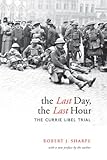
Robert J. Sharpe. The Last Day, The Last Hour: The Currie Libel Trial. Toronto: Published for the Osgoode Society for Canadian Legal History by University of Toronto Press, 2009. xiv + 270 pp. $29.95 (paper), ISBN 978-0-8020-9619-7.
Reviewed by Brock Millman (University of Western Ontario)
Published on H-Law (September, 2011)
Commissioned by Christopher R. Waldrep (San Francisco State University)
Sir Arthur Currie was the commander of the Canadian Corps during the First World War (1917-18), and a curious figure. On the one hand, military historians commonly consider him to have been one of the most--if not the most--effective operational commanders of the First World War. On the other hand, he was a man curiously unloved, un-admired, and without personal charisma. By 1917, there was no position on the western front which Currie’s corps could not storm. The troops he commanded routinely took impregnable positions at the lowest cost available, still hefty. This did not prevent detractors from indicating him as a butcher, generally described as an odd figure who moved through his headquarters like the “company cook,” and who sat his horse like a sack of flour. Even his own soldiers do not seem to have been inspired, notwithstanding their victories. Lesser generals who lost at greater cost were loved far more than Currie, who always produced the goods at a bargain-basement price. In 1918, Currie’s corps--the “shock army of the British Empire,” the “spearhead of victory”--led his corps during the series of offensives which culminated with the armistice. His single corps took more ground, more prisoners, and inflicted as much damage on the German army opposed as the rest of the British army combined. On November 11, 1918, Currie’s war ended in Mons where the British Empire’s war had begun.
Ever thereafter Currie was the subject of criticism and controversy. Initially, enemies whispered. In June 1927, the Port Hope Daily Guide--a paper without significance--opined that Currie had deliberately prolonged operations until the last possible minute in pursuit of vainglory, thus incurring Canadian casualties that were absolutely avoidable. He had aimed, from pride, to finish the war in Mons. Other men had paid the price. Why did anybody have to die after the armistice had been signed? Currie sued for damages, uniquely among Great War generals. A long and terrible trial ensured during which Canada revisited the minutiae of who had been killed when and to what effect. Currie won a pyrrhic victory. His claim was admitted, but his reputation in his own country has never entirely recovered. This legal action is the fascinating subject of Sharpe’s book.
This book has been republished for a reason. It deserves to be read. It is an excellent book which received far less attention than it deserved on first publication in 1988. It should be of interest to a wide audience, extending far beyond the Canadian lawyers who initially caused it to be published.
Sharpe is scrupulous with historical and legal evidence. Many publications concerning developments at home before, during, and after the war in Canada or elsewhere are not. Such writing is strong on emotion and outrage. Sharpe provides a dispassionate exposition of the law and the history. Sharpe’s research is thorough. He is painstaking concerning statute and precedent. Such issues, of course, must be decisive in consideration of legal history. He is useful in another fashion. I would consider using the book with students as a model of historical writing. It is carefully written and no word is wasted. Having read it three times, I fail to find a single suspect fact or interpretation, and very few words or phrases that could be replaced by better. It is seldom that that can be said.
The book is worth a look in by others than legal or Great War historians. The story concerns a topic of considerable contemporary interest. What was tried in Cobourg was a sequence of events at the end of a great and terrible war--the antithesis of a quiet courthouse in a rural Ontario town, at peace. The finding hinged, ultimately, on the issue of whether one man had died unnecessarily to feed the highest commander’s vanity. The author does not say but he does suggest that Currie was treated shamefully. The last page of the book should embarrass any Canadian reader while providing warning for contemporary readers.
If there is additional discussion of this review, you may access it through the network, at: https://networks.h-net.org/h-law.
Citation:
Brock Millman. Review of Sharpe, Robert J., The Last Day, The Last Hour: The Currie Libel Trial.
H-Law, H-Net Reviews.
September, 2011.
URL: http://www.h-net.org/reviews/showrev.php?id=33905
 | This work is licensed under a Creative Commons Attribution-Noncommercial-No Derivative Works 3.0 United States License. |

