


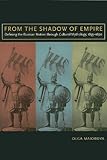
Olga Maiorova. From the Shadow of Empire: Defining the Russian Nation through Cultural Mythology, 1855-1870. Mellon Slavic Studies Initiative Book Series. Madison: University of Wisconsin Press, 2010. xv + 277 pp. $29.95 (paper), ISBN 978-0-299-23594-9.
Reviewed by Susan P. McCaffray (University of North Carolina at Wilmington)
Published on H-Russia (August, 2011)
Commissioned by Teddy J. Uldricks (University of North Carolina at Asheville)
Writing the Nation
Olga Maiorova’s From the Shadow of Empire analyzes a number of cultural productions from the reform era to produce a striking group portrait of mid-nineteenth-century nationalists. Maiorova brings to bear her considerable erudition as a scholar of nineteenth-century Russian literature and her immersion in the political and cultural history of the era. While others have explored the juxtaposition of imperial expansion and growing national consciousness, Maiorova demonstrates that situating this encounter in its reform-era context illuminates the emergence of national mythmaking. As the “nation” came increasingly to be understood as a political construct, its relationship to both “state” and “empire” became problematic. The works she discusses variously distinguish, conflate, and reimagine all three of these, but the primary project of the period, in Maiorova’s telling, was to locate the “national” within the state-empire paradigm.
She characterizes Russia’s educated elite at the beginning of Alexander II’s reign as shocked by the Crimean defeat, traumatized by what it revealed about Russia’s economic and civil incompetence, and gripped by a “gnawing sense of systemic failure” (p. 7). She assembles an eclectic group of “intellectuals of nationalist persuasion,” which includes Slavophile Ivan Aksakov, poet Fedor Tiutchev, newspaper editor Mikhail Katkov, Pan-Slav Mikhail Pogodin, historian Nikolai Kostomarov, and literary lion Lev Tolstoy, among others, following them through a series of cultural episodes whose connectedness she convincingly asserts (p. 9).
In the aftermath of military defeat in 1856, the chief patriotic symbols of the Nicolaevan era underwent important transformations. The Patriotic War of 1812, often invoked as a reminder of the sacred and powerful union of people, army, and monarch, appeared in diaries and stories of the late 1850s increasingly as a sign of how much the country had decayed under a stultifying regime that no longer believed in its people. Likewise, Tolstoy’s Cossacks (1863) separated these freedom-loving, equality-embracing volunteer soldiers from the bureaucratic state and even from the conventional steppe landscape of imperial Russia’s core. Thus the work of undermining the long-asserted bond among state, empire, and people commenced.
In 1862, Alexander II presided over an elaborate celebration of the millennium of Rus’ that culminated in the dedication of a monument in Novgorod’s Sophia Square. During the years of planning for this event, the meaning of the country’s founding epic, the so-called invitation to the Varangians, became a richly contested myth. Maiorova considers three competing readings of this story by Kostomarov, Katkov, and S. A. Gedeonov. Despite important differences among them, as a whole these writers of the 1860s recast the summoning of the Varangians as an act of popular agency, one in which the Slavs had taken the lead, subsuming non-Slavic peoples in the political entity that arose.
Reform-era nationalists sought to locate the origins not only of the state, but also of the nation. In his 1862 To the Slavs, Pogodin saw the mission of Cyril and Methodius one thousand years before as forming the Orthodox Russian people while also connecting Russians to other Orthodox Slavs through the Old Church Slavonic language. This Pan-Slavic project, locating in the year 862 the founding moment of both state and people, interwove the competing concerns of Russian nationalists, bringing together “national and religious identities and glorification of the Russian people’s imperial vocation as the primary means of bringing salvation to all Slavs” (p. 160).
War appeared in many of the period’s writings as formative experiences of the nation. For example, responding to the Polish Rebellion of 1863, Katkov and Aksakov drew on the wars of 1612 and 1812--when the threat to Russia either originated in or was transmitted via Poland. The following year, Alexander II commemorated the army’s campaign of 1813-14, in which his august uncle had played a prominent role. Together these martial memories served “to virtually transform the Romanov empire into a national one” (p. 117). Two literary works begun in 1863, Tiutchev’s “A horrid dream has been burdening us” and Tolstoy’s War and Peace (1869), saw war as energizing a national community that had not come together in any other way. Each imbued Russian identity with providential purpose, hinting at a religious, rather than a purely “ethnic,” nationalism. There were important differences between them, however. Tiutchev saw Russia bearing a universal, imperial mission while Tolstoy framed 1812 as a purely Russian story, in which the French invasion did not stir up popular reaction until it passed the “Polish provinces” west of Smolensk (p. 147).
In the 1860s and 1870s, extracting the nation from the imperial state was a literary, commemorative, and historical effort that leaned heavily on war memories. Writers of a nationalist persuasion perpetuated and reinforced the notion that a nation is formed by war. In the long run, Maiorova concludes, the martial imagery embraced by mid-century nationalists legitimized the ruthlessness and the Russification program of the last two Romanovs.
This summary omits most of the elegant nuances of Maiorova’s analysis. As a literary scholar, she is well positioned to mine these texts, and her readings at times are so sensitive that she all but undermines the analytical categories she has constructed. This tendency underscores her most important insight, however. Maiorova demonstrates that from the mid-nineteenth century, writers of Russian nationalism attempted to distinguish among nation, state, and empire, but they found that these categories were not entirely stable and not reliably distinct. This made the effort a thrilling intellectual project, and one that continues in our time. This book could profitably be read as background not only for the sad campaigns in Chechnya, but also for the striking moment in 1991 when the Russian Federation seceded from the U.S.S.R.
Maiorova makes it clear that Russia’s mid-century nationalists were listening to each other. The question of whether anyone else was listening to them is a matter for historians. It is to be hoped that one day historical scholars will get around to wondering about such things and return v narod, where at least part of the story of Russian nationalism must be awaiting its chronicler.
If there is additional discussion of this review, you may access it through the network, at: https://networks.h-net.org/h-russia.
Citation:
Susan P. McCaffray. Review of Maiorova, Olga, From the Shadow of Empire: Defining the Russian Nation through Cultural Mythology, 1855-1870.
H-Russia, H-Net Reviews.
August, 2011.
URL: http://www.h-net.org/reviews/showrev.php?id=31786
 | This work is licensed under a Creative Commons Attribution-Noncommercial-No Derivative Works 3.0 United States License. |

