


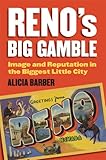
Alicia Barber. Reno's Big Gamble: Image and Reputation in the Biggest Little City. Lawrence: University Press of Kansas, 2008. x + 319 pp. $34.95 (cloth), ISBN 978-0-7006-1594-0.
Reviewed by Brandi Burns (City of Boise, Idaho)
Published on H-Urban (April, 2010)
Commissioned by Robert C. Chidester (The Mannik & Smith Group, Inc.)
Reno’s Reputation and Sense of Place
Alicia Barber explores Reno and its reputation in her book, Reno’s Big Gamble. Her overarching thesis is that Reno provides an example of a city that has struggled from day one to take control over its reputation. Barber is also using Reno as a case study that examines tourism in the western United States, and how it collides but also works together with the residential population of a city. She emphasizes that this is particularly important because in the West, “tourist and residential landscapes have long coincided and ... both will continue to expand and intersect in the years to come” (p. 10). Reno also serves as a warning to other cities that are willing to define themselves according to the latest trends in society. Barber explains that Reno has been more than willing to change its image to fit the desires of mainstream culture in the United States. The strength of Barber’s analysis is in how she illustrates this point throughout. In addition, her book is useful for professionals in the urban history field because it illustrates the growth and decline of a western city that developed using “sin” as its main attraction.
The strength of Barber’s book is that she incorporates her thesis about Reno’s reputation throughout, providing several examples of how Reno has reinvented itself for economic gain. She traces Reno and its reputation from its founding in 1868 to 2008. Barber writes, “To study the relationship between a place and its reputation is to trace a process that has no clear beginning” (p. 11). Despite the difficulty that this poses, the author seems to start her study in a logical place and traces the various influences on Reno’s reputation, from the legalization of gambling to its divorce industry, and the various upswings and downswings in the popularity of these two industries. Barber gives ample evidence from newspapers; archival documents, such as brochures and oral histories; and many books and articles concerned with Reno, as well as literature on cities in general. She examines Reno’s reinvention continually throughout the book, discovering that Reno’s evolving reputation was influenced more by small special interest groups, such as casino owners, than by official city organizations, like the Chamber of Commerce.
There are no significant weaknesses in Barber’s analysis, but she does mention “sense of place” several times in the introduction, a topic that she does not specifically draw attention to during the rest of the book. However, this is not a weakness that interferes with Barber’s message because the careful reader gets a sense of the duality of Reno, which provides a different sense of place for its residents than for the many tourists who frequent the town. Barber has pulled together a tremendous amount of material to trace Reno’s identity as it has changed over time, and has tied all of that information together succinctly.
Barber’s book is distinctly urban history, and should be read by anyone interested in how a city responds to external and internal demands. She explains that Reno has been especially responsive to demands on what it should look like, and the purposes it should serve. She illustrates that Reno has continually tried to balance what its residential population wants with what the casino district has wanted. Some of these responses include the flurry of casino building in the 1970s, and the 1990s-2000s revitalization efforts of the declining casino district and downtown core. Barber explains that the decline of Reno occurred as a result of “the failure of civic leaders to recognize the balance of resident and tourist space, the overall aesthetic appeal, that had in the past ensured a reputation that worked, for the most part, in Reno’s favor” (p. 10). This is the major thrust of Barber’s argument--that it was not until the residents’ desires were being ignored that Reno began to decline. The decline happened because Reno, in its pursuit of tourism revenue, neglected to provide its residents with a town that had places and avenues that its residents wanted. The leaders of the city and casino owners assumed residents would also want to spend all of their time in a shiny new casino. Before this, tourists and residents coexisted because the casinos were not trying to push out other businesses to build more casinos, like they did in the 1970s, and residents were not trying to push out the casinos. Reno survived so long because of its willingness to reinvent itself, and because of this Reno becomes a case study for other cities that are facing similar economic and identity problems.
In all, Barber provides a well-documented examination of Reno’s ability to reinvent itself. She writes, “This, in essence, was Reno’s big gamble: risking its reputation, along with its aesthetic appeal, time and time again, in the dogged pursuit of economic gain” (p. 11). Despite this, it appears that Reno has remained successful, even if it is on a smaller level than other larger cities, like Las Vegas. The ultimate strength of the book is Barber’s ability to make this examination a useful case study for other cities to consider, and for professionals to examine how the cities they are studying have created a sense of place.
If there is additional discussion of this review, you may access it through the network, at: https://networks.h-net.org/h-urban.
Citation:
Brandi Burns. Review of Barber, Alicia, Reno's Big Gamble: Image and Reputation in the Biggest Little City.
H-Urban, H-Net Reviews.
April, 2010.
URL: http://www.h-net.org/reviews/showrev.php?id=29614
 | This work is licensed under a Creative Commons Attribution-Noncommercial-No Derivative Works 3.0 United States License. |

