


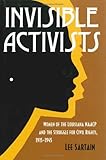
Lee Sartain. Invisible Activists: Women of the Louisiana NAACP and the Struggle for Civil Rights, 1915-1945. Louisiana State University Press, 2007. 212 pp. $36.50 (cloth), ISBN 978-0-8071-3221-0.
Reviewed by Deanna Gillespie
Published on H-SAWH (April, 2009)
Commissioned by Antoinette G. van Zelm (TN Civil War Nat. Heritage Area Center for Historic Preservation)
Out of the Shadows: Black Women's Activism in Louisiana
Lee Sartain’s study of African American women in National Association for the Advancement of Colored People (NAACP) branches in Louisiana joins a growing body of literature that traces the roots of the civil rights movement to grassroots leadership in the early twentieth century. Specifically building on work by Adam Fairclough and Patricia Sullivan, Sartain provides further evidence of southern NAACP leaders’ persistence in the Jim Crow South.[1] Sartain continues Fairclough’s examination of black women’s leadership, highlighting “invisible activists” who, according to Sartain, held “important official posts in the NAACP and were an indispensable part of the membership that kept the organization active in Louisiana” (p. 2).
Restoring “invisible” activists to the narrative of the early civil rights movement in the South is certainly a challenging task. To achieve this goal, Sartain draws on a variety of primary sources to describe the “multifarious roles” that middle-class black women played in local communities (p. 14). Using membership lists, committee records, and personal letters, Sartain’s work examines women’s involvement and leadership within NAACP chapters as well as their broader connections through extensive social networks. The strengths of the study lie in Sartain’s careful and meticulous recreation of these networks and in his reformulation of black women’s activities and contributions as grassroots leadership.
While his source base allows Sartain to restore black women’s activities to the narrative, his sources also seem to contribute to the study’s limitations. Membership lists and committee reports provide a snapshot in time, listing specific people and providing differing degrees of details about particular activities. Sartain mines these sources for evidence of black women’s work but does not fully utilize sources that would allow him to describe the local context in which these women lived and functioned. Sartain acknowledges these research challenges but claims that “the fragments provide a reasonable picture of women’s complex and integrated lives as social reformers and political activists” (p. 13). In the end, Sartain’s study seems to raise more questions than it answers.
Invisible Activists opens with a chapter that traces the history of the national NAACP organization from 1909 to 1945. Throughout the chapter, Sartain generalizes from secondary literature and national NAACP records. Intended to provide an overview and set the context for the remainder of the book, the chapter instead delays the real focus of the work: black women’s involvement and leadership in Louisiana. By separating the national NAACP history into one chapter, Sartain places the burden on the reader to integrate this broader overview into the more detailed chapters that follow. Given the focus of the book, an overview of Louisiana and the unique character of its local communities would have been more helpful as an introduction to the book.
The remainder of Sartain’s study is organized thematically. He begins to hit his stride in the second chapter, tracing black women’s involvement in local civil rights activities prior to 1920. In this chapter, Sartain introduces central themes, including the influence of class and gender in local communities and tensions between local chapters and the national organization. Scholars familiar with the historiography of southern black women’s community activities during the Jim Crow period will find few new insights in this chapter. Throughout, Sartain uses evidence from Louisiana organizations to reinforce scholars’ earlier work on the politics of respectability and the influence of gender and class in local communities.[2] Following more recent historiographic trends, readers will likely raise questions about the intra-community dynamics between Sartain’s largely middle-class historical actors and the intended recipients of their social reform efforts. How did the local context influence acceptance of, or resistance to, reformers’ efforts, particularly in urban areas like New Orleans? Without this layer of analysis, Sartain’s work seems to homogenize Louisiana women’s experiences rather than draw new conclusions.
In subsequent chapters, Sartain explores NAACP branch ladies’ auxiliaries, black female teachers’ leadership, and black women who served as elected officials in NAACP branches. Within each chapter, Sartain subdivides these broad subjects into subcategories that he uses to describe black women’s activities. Through these descriptions, readers gain an understanding of the many roles that African American women played in local chapters, particularly in New Orleans, Baton Rouge, and Monroe. Sartain’s painstaking research into both local NAACP records and records from other community and social organizations reveals that black women coordinated membership drives, organized and managed fundraising activities, and led local Youth Councils. Through these activities, according to Sartain, black women “directed their energies and resources into a battle against segregation that would reinforce middle-class values and prevailing gender perceptions, particularly the patriarch-led family” (p. 59). Sartain further argues that black women “made up the margin of viability for most branches” (p. 59). While the thematic approach allows Sartain to document a variety of activities, the format makes it challenging for readers to follow a narrative flow, both in terms of chronology as well as specific local leaders’ experiences within local chapters.
Throughout these chapters, Sartain drops tantalizing clues about intriguing differences between Baton Rouge, New Orleans, and Monroe. For example, in a discussion of the “musical scene” in Depression-era New Orleans, Sartain points out that the local NAACP chapter recruited from “the reputable division of the … scene, namely classical music.” According to Sartain, this “reflected middle- and upper-class sensibilities, rather than the growing jazz or blues scene” (p. 72). This is a missed opportunity to situate the history of black women’s NAACP activities within the cultural life that was so central to the city’s history. Did NAACP activists interact with blues singers and club owners who would have represented a significant financial resource within the urban black community? If not, what was the overall effect of two (or more) separate and uncoordinated community-building efforts? Similarly, Sartain describes black female teachers’ involvement in the New Orleans branch's leadership. Drawing on a report from the Federal Bureau of Investigation (FBI), Sartain describes the dominance of a small elite group, leaving readers to wonder why the branch was under FBI surveillance in the mid-1940s, whether other branches in the state drew similar federal attention, and the ways in which this federal intervention affected local activism.
Sartain’s last chapter on Miss Georgia M. Johnson of Alexandria, Louisiana, demonstrates the value in using location as the central organizing theme. In this chapter, readers get a good sense of place and time through rich descriptions of the growth of military bases in and around central Louisiana during World War II. Georgia M. Johnson’s leadership is clearly situated within a rapidly changing urban environment and growing factionalism within the local branch. According to Sartain, Johnson’s very public and “more militant” approach to civil rights issues stood in contrast to the majority of black women described in the previous chapters (p. 129). This case study points to the complexity and diversity within African American communities. Sartain’s study would be strengthened with further exploration of these dynamics throughout the book.
In conclusion, Sartain’s work contributes to a growing body of literature that traces the roots of the modern civil rights movement to grassroots efforts in southern communities in the Jim Crow South. Sartain restores “invisible” activists to this narrative, describing middle-class and elite black women’s leadership in Louisiana communities. Working within the contemporary gender and class expectations, these women mobilized extensive social networks to ameliorate the effects of Jim Crow segregation and to uplift their communities. Sartain’s study will appeal to scholars interested in black women’s community work during the early twentieth century.
Notes
[1]. Adam Fairclough, Race and Democracy: The Civil Rights Struggle in Louisiana, 1915 -1972 (Athens: University of Georgia Press, 1995); and Patricia Sullivan, Days of Hope: Race and Democracy in the New Deal Era (Chapel Hill: University of North Carolina Press, 1996).
[2]. See for example, Glenda E. Gilmore, Gender and Jim Crow: Women and the Politics of White Supremacy in North Carolina, 1896-1920 (Chapel Hill: University of North Carolina Press, 1996); Deborah Gray White, Too Heavy a Load: Black Women in Defense of Themselves, 1894-1994 (New York: W.W. Norton & Co., 1999); and Evelyn Brooks Higginbotham, Righteous Discontent: The Women’s Movement in the Black Baptist Church, 1880-1920 (Cambridge, MA: Harvard University Press, 1993).
If there is additional discussion of this review, you may access it through the network, at: https://networks.h-net.org/h-sawh.
Citation:
Deanna Gillespie. Review of Sartain, Lee, Invisible Activists: Women of the Louisiana NAACP and the Struggle for Civil Rights, 1915-1945.
H-SAWH, H-Net Reviews.
April, 2009.
URL: http://www.h-net.org/reviews/showrev.php?id=23454
 | This work is licensed under a Creative Commons Attribution-Noncommercial-No Derivative Works 3.0 United States License. |

