


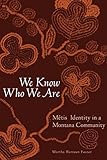
Martha Harrows Foster. We Know Who We Are: Métis Identity in a Montana Community. Norman: University of Oklahoma Press, 2006. 306pp. $29.95 (cloth), ISBN 978-0-8061-3705-6.
Reviewed by Susan Sleeper-Smith (Department of History, Michigan State University)
Published on H-AmIndian (March, 2007)
Kinship and Community
This book addresses the issue of Métis identity in the communities that border Canada and the United States. It focuses on Montana, where communities continued to persist, despite being disrupted by federal land policies as well as racial bigotry and hatred, on both sides of the border. This is a book is about the nature of being Métis, and it explores how these people established and maintained their distinctive identity as they moved west from the Great Lakes to the Great Plains. What is especially distinctive about Martha Foster's book is her attempt to tell a story that occurred south of the Canadian border. Much of this literature has focused on Canada and on the events that transpired as the Métis struggled for recognition as a First Nation. But south of the border, they were relatively invisible because federal policies predetermined their identity and forced them to ally with the various Chippewa bands in the region. The United States refused to recognize them as a distinctive people.
For Foster, it was the Spring Creek band of central Montana Métis that founded many of the early communities that stretched along the river ways from the western Great Lakes to the Great Plains and north to the Red River. In the first half of the nineteenth century, these Métis communities faced increasingly restrictive racial and national identities in both the United States and Canada, each national government ascribed specific identities to them. In the United States they were considered Indian. Despite their distinctive lifestyles, language, and residence patterns, the government refused to separate them from adjacent Indian communities. Simultaneously, the Canadian government refused to negotiate with them as Métis and, instead, directly distributed land to them based on their more "civilized lifestyles." The Métis were awarded title to a fixed number of acres. Despite these dissimilar outcomes, both north and south of the border, neither group would have elected these more limiting ethnic identifications.
Many settled Métis communities were forced to become semi-nomadic during the course of the nineteenth century. Bovine diseases reduced the size of the buffalo herds. As the Métis pursued the remaining buffalo into Saskatchewan, Alberta, and Montana, the broader populace increasingly depicted them as failed agriculturalists, who "voluntarily" reverted to more primitive instincts. To outsiders, their movement seemed the rejection of farming rather than judicious economic decision-making. Not only did homesteaders in Montana see them as transients, but they were increasingly regarded with suspicion following the Battle of Little Big Horn. As the army dramatically increased in size, from 700 to 3,300, the Métis were mistakenly blamed for supplying the Sioux with trade goods that they had purportedly smuggled in from Canada. Repeatedly during the 1870s, their civil rights were violated as they were expelled from the United States by reservation agents and government officials. By early 1879, many exiled families had banded together and they moved into the Judith Basin. Here, they were informally referred to as the Spring Creek band. Although patriarchal families appeared to predominate in the membership, the author points out the underlying importance of Catholic mixed-descent women in the evolution of the Spring Creek band organization. Interestingly, Foster contends that "all of the family names belonging to Spring Creek band members or their parents can be found among those working for the North West Company in the Northwest before 1821" (p. 82). Martha Foster provides a thorough description of the Spring Creek Métis and dismisses the misperception that the Montana Métis were landless Indians. She relies on homestead records to show that these families settled on homestead lands, met the requirements, and received deeds to their lands. They increased the permanence of their community by constructing cabins, despite severely limited access to tools, and outsiders considered them a settled community. Their religious needs were met by missionary priests and, by the 1880s, they attempted to insure their interests by working with Louis Riel, although these efforts were less than successful. In fact, it was in the 1880s that the Spring Lake communities came under increasing pressure as the buffalo herds fully died out and the first cattle corporations came to dominate the grasslands. It was the disappearance of the herds that had overwhelming consequences, and by 1884 their community was economically depressed. With the influx of ranching families, the Métis quickly lost control of the community and it was renamed Lewistown. While they continued to vote in elections, send their children to school, and support the Catholic Church, they no longer had Métis candidates running for office. By 1900, even control of the church was lost. Between 1900 and 1919, the government again forced the Métis to self-identify as Indians at the expense of a public Métis identity. Distinctive terms of identity were no longer used and the stereotype evolved that the Métis were Cree and Canadian. But among family and friends, their kinship networks led to their persistence and they continued to insist that they were "breeds." Some self-described as French Canadian, signaling yet another commitment to their unique cultural heritage. For the Spring Creek Métis, identity and kinship were interwoven and it is this heritage that these people now publicly celebrate.
This book is a welcome addition to the literature, it focuses on how kinship ties encouraged the evolution of a distinctive ethnic identity. Although some earlier studies by Jacki Peterson, Lucy Murphy, and myself explore earlier time periods, Martha Foster's work brings this understanding of ethnic distinctiveness into the present day. While most of this scholarship has focused on kinship, there is little to tell us how these structures worked to knit people together into a community. Foster has done an admirable job in tracing the roots of these kinship links, but the story of how those networks functioned on a daily basis remains to be told. It is here that one hopes that Foster will continue to focus her efforts, demonstrating what kinship actually meant when people faced starving times, the death of parents, or served as godparents to each other's children.
If there is additional discussion of this review, you may access it through the network, at: https://networks.h-net.org/h-amindian.
Citation:
Susan Sleeper-Smith. Review of Foster, Martha Harrows, We Know Who We Are: Métis Identity in a Montana Community.
H-AmIndian, H-Net Reviews.
March, 2007.
URL: http://www.h-net.org/reviews/showrev.php?id=12909
Copyright © 2007 by H-Net, all rights reserved. H-Net permits the redistribution and reprinting of this work for nonprofit, educational purposes, with full and accurate attribution to the author, web location, date of publication, originating list, and H-Net: Humanities & Social Sciences Online. For any other proposed use, contact the Reviews editorial staff at hbooks@mail.h-net.org.

