


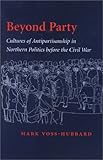
Mark Voss-Hubbard. Beyond Party: Cultures of Antipartisanship in Northern Politics before the Civil War. Baltimore: Johns Hopkins University Press, 2002. xii + 266 pp. $47.00 (cloth), ISBN 978-0-8018-6940-2.
Reviewed by Timothy Roberts (Department of History, Bilkent University)
Published on H-CivWar (August, 2006)
The Significance of Antebellum Populism
Mark Voss-Hubbard, assistant professor of history at Eastern Illinois University, has produced a study of an antiparty movement in three northern counties to assess the relation among economic change, political insurgency, and populism in the late antebellum period. Voss-Hubbard acknowledges the importance of nativism and eventually antislavery to the movement, known popularly as the Know Nothings, beginning with elections in 1854. But he emphasizes that "vernacular antipartyism," "the antipolitician and antiparty themes of insurgent political discourse, and ... the more generalized ambivalence toward professional politicians and parties embedded in American culture," was its central impulse (p. 4). His work thus contrasts with the study by Tyler Anbinder, Nativism and Slavery: The Northern Know Nothings and the Politics of the 1850s (1992), meanwhile explaining the point made by William Gienapp, in Origins of the Republican Party, 1852-1856 (1986), that the Know Nothing party was one of the most important in American history. More than Gienapp, Voss-Hubbard emphasizes the impact changing patterns of commerce made on local communities.
Voss-Hubbard focused his study on areas that were regionally diverse, yet in all three counties and their respective states, Know Nothings gained power. Railroads and large-scale manufacturing undermined traditional reliance on small shop production in New London County, Connecticut; Essex County, Massachusetts; and Dauphin County, Pennsylvania, although the latter remained essentially agricultural. While in no county was one in five residents an immigrant by 1860 (in Dauphin County it was one in twenty), all experienced rapid immigration in the previous decade, especially by Catholics, on whom the native-born blamed their anxiety over cultural diversity and job competition.
Prohibition and a ten-hour workday, then, along with petitions to extend immigrants' naturalization period to twenty-one years and proscription of immigrants from office-holding (although these latter issues appear less important, based on the brevity of the author's references to them) were all responses to the new economic and cultural turbulence of the late antebellum North. And they became the issues that destabilized the second party system, because they established a vibrant antiparty anger among men and women in northern communities.
The first part of Voss-Hubbard's book tells of numerous examples in the counties and states in question when Whig and Democratic state government officials did not act on grass-roots initiatives. Whig reticence often stemmed from reluctance to change state constitutions and to employ state police power to regulate private enterprise; Democratic reticence often reflected the preferences of their immigrant constituencies. This inaction by both of the traditional political parties only confirmed to single-issue organizers the republican selflessness of their own causes. That anti-liquor and pro-labor positions might themselves have been "special interests"--as the author describes the Know Nothings' perception of "Roman Catholics, dough-face northern Democrats, slaveholders, and others"--seems not to have occurred to or distracted them (p. 11).
Voss-Hubbard defers to the interpretation of Michael Holt that settlement of the 1850 Compromise facilitated a turn in American politics towards state issues, and therefore "constituted a crucial political opportunity" for local reformers (p. 73).[1] But the thrust of his argument actually is that the Know Nothings' existence had very little to do with the slavery question until passage of the Kansas-Nebraska Act in the summer of 1854. This was a significant controversy because it heightened fears among native-born white northerners of economic dislocation and unsympathetic government.
A critical, and perhaps inevitable, step occurred in the all-too-brief Know Nothing history by 1855. Of the three states Voss-Hubbard analyzes, only Massachusetts saw completely independent tickets. Yet the Know Nothings gained dozens of congressional seats, governorships and legislative majorities in several states, and election to countless local offices. (Though the book's appendix shows gubernatorial and presidential returns for Essex, New London, and Dauphin counties from 1840 to 1860, other state and local election results are not quantified.) Again, other historians, such as Anbinder and Richard Sewell (Ballots for Freedom: Antislavery Politics in the United States, 1837-1860, 1976) have dated the Know Nothing downfall to the American Party's adoption of a national platform endorsing popular sovereignty, meaning local not federal authority over slavery in the western territories. This action triggered breakaway movements among Know Nothing states favoring antislavery free soilism.
Voss-Hubbard acknowledges these stormy national events, but his focus on local history reveals that discontent with and among the Know Nothings could be found well before proslavery interests seized control at the national level. It seems that the Know Nothings' "antiparty vernacular" got them in trouble, once having achieved political offices. Know Nothings' secret rituals, for example, came to seem juvenile or suspicious. Likewise, ironically, Know Nothings proved dogmatic about party line voting, mercenary about patronage, and susceptible to corruption. In Connecticut, the state Know Nothing organization revoked the charters of several lodges when it found their members had voted their conscience, instead of the Know Nothing ticket. In Massachusetts, a legislator was revealed to have "made lewd remarks and gestures to nuns ... [and] charged the Commonwealth for an evening of smoking, drinking, and sex with a prostitute" (p. 173). The legislator was the Know Nothings' state Grand Worshipful Instructor; as a Know Nothing office holder, he had launched an investigation of a Catholic boarding school for moral impropriety. As Mark Summers has described in detail, in Plundering Generation: Corruption and the Crisis of the Union, 1849-1861 (1987), all such shenanigans were ordinary aspects of American politics in the 1850s--but this was the rub. According to Voss-Hubbard, "Know Nothings had campaigned on the theme that theirs was no ordinary time" (p. 176). But the duality of antipartyism and "the pressures inherent in the prevailing culture of governance" quickly undermined their appeal (p. 176).
Thus, Voss-Hubbard explains the fusion of northern Know Nothings with the Republican Party's inaugural presidential campaign in 1856, as well as the rapidly developing Republican sectional appeal, as much in terms of the Republican "populist and nonpartisan cast" as in the Republicans' firm antislavery position (p. 197). The author puts stock in the words of an Essex County newspaper editor, who described the movement that nominated John C. Fremont not as the result of "party leaders, but of the PEOPLE themselves, breaking away from all party connections" (p. 197). However, this argument for the antiparty focus of Republican populism as an effort "to restore a moral purpose to partisan politics" (p. 216) is not as persuasive as is his depiction of the early antiparty focus of Know Nothing populism. For example, the Republicans chose Simon Cameron to run for a U.S. Senate seat, and Nathaniel P. Banks for a state governorship. That Cameron was "a career office-chaser" (p. 201) and Banks had a "chameleon-like political career [which] illustrates best his true talent" (p. 205) hardly disqualified them from Republican support. Both candidates had bona fide free soil credentials, but such expedient choices suggest a calculated Republican use of the party system, not a disavowal of its untrustworthiness and search for new men. Moreover, slavery re-emerged as a mobilizing issue as a result of the violence in the Kansas territory and the U.S. Supreme Court's Dred Scott decision. Slavery probably made the Republican cause seem moral and nonpartisan in a sustained way, despite the party's electoral success through and after 1860, a level of success that the Know Nothings could never achieve.
In its heavy attention to the rise and fall of the Know Nothings in three northern counties, Beyond Party, of course, says little about the history of the movement elsewhere at the state or national level. However, the book is valuable for making explicit the importance of producerism and nativism to this early episode of American populism. Moreover, in its emphases on the Know Nothing movement's organizational innovations and origins in economic dislocation, it is valuable for complicating views of the movement as essentially antislavery or nativist. Reading Beyond Party would be a valuable exercise for students in courses in U.S. political history or political science.
Note
[1]. See Michael Holt, Political Crisis of the 1850s (New York: Wiley, 1978); and Rise and Fall of the American Whig Party: Jacksonian Politics and the Onset of the Civil War (New York: Oxford University Press, 1999).
If there is additional discussion of this review, you may access it through the network, at: https://networks.h-net.org/h-civwar.
Citation:
Timothy Roberts. Review of Voss-Hubbard, Mark, Beyond Party: Cultures of Antipartisanship in Northern Politics before the Civil War.
H-CivWar, H-Net Reviews.
August, 2006.
URL: http://www.h-net.org/reviews/showrev.php?id=12198
Copyright © 2006 by H-Net, all rights reserved. H-Net permits the redistribution and reprinting of this work for nonprofit, educational purposes, with full and accurate attribution to the author, web location, date of publication, originating list, and H-Net: Humanities & Social Sciences Online. For any other proposed use, contact the Reviews editorial staff at hbooks@mail.h-net.org.

